Sunday, July 29, 2012
One of my passions is collecting shells. Even though I don't live in Florida, where I understand people fill garages with them, I have accumulated a good selection.
They are my favorite subject for drawing. Beside that, I have often thought about putting my own claywork in a drawing.
This is a little bowl that is long gone from my inventory, but at the time, it made a very good background for these small shells referred to as "Blood Mouths" because of their vividly red lips. The drawing is done in colored pencil on a light blue paper.
Blood-mouths* are often mistaken for cone shells, but they are really conch shells, common to Guam, where I collected these and first started diving.
*Strombus luhuanus. Also known as the Blood-mouth Conch, this sea shell features a dark brown columellar and a reddish inner lip. This animal lives in colonies and is This seashell is common to Western Pacific on sand to 5 fathoms. Measures approx 1. 5" - 2".
Saturday, July 21, 2012
A Most Interesting Spout
I have this coffee pot. I've owned it for many years. It was part of a drip coffee set that has the pot on the bottom and a funnel-shaped porcelain filter holder that sits atop it. You insert a paper filter, fill it with grounds, pour hot water through the grounds and the coffee drips down into the pot. Not unusual.
But what is unique, at least to me, is the spout on the pot. It has a very graceful shape. And the end of the spout has a groove on the underside and a small slot-like hole in it. The groove is angled with the spout shape, but the hole is level with the bottom of the pot.
Because of this design, not a drop develops on the end of the spout . Somehow, the groove and the hole causes the volume of the liquid to go back into the pot via the spout throat and not drip or cling to the end of the spout.
The pot was made in Germany and I have a feeling this design is one that has been used there, perhaps in other places in Europe, for a very long time.
I'm going to try and incorporate this design into my next teapot and see if I can get it to work.
Does anyone know the origin of this design and have any more information about it?
But what is unique, at least to me, is the spout on the pot. It has a very graceful shape. And the end of the spout has a groove on the underside and a small slot-like hole in it. The groove is angled with the spout shape, but the hole is level with the bottom of the pot.
Because of this design, not a drop develops on the end of the spout . Somehow, the groove and the hole causes the volume of the liquid to go back into the pot via the spout throat and not drip or cling to the end of the spout.
The pot was made in Germany and I have a feeling this design is one that has been used there, perhaps in other places in Europe, for a very long time.
Does anyone know the origin of this design and have any more information about it?
Labels:
Clay Engineering,
coffee pots,
teapots
Thursday, July 12, 2012
Bottles
I was experimenting with corks and came up with an idea to cap a wine cork by glueing a top onto the cork after it was fired. Getting the measurements just right is a bit of a hassle, but the cork is secure and fits. I used Goop to attach it to the top.
I really like the way the celadon pooled over the white glaze in the short pot.
I made applied 'buttons' as decorations. The button is actually patterned with a real antique button mold. I made the mold with clay, fired it, then pressed the soft clay button into the bisque mold to reproduce the original button form. You could do this with many different kinds of molds to make all kinds of button decorations on your pots.
The small piece only has a sort of spike shaft at the bottom of the cap. It rattles around right now, but I will find the right cork and hollow it out to fit the shaft.
I like the balance of this tall bottle. Great for single branches and tall flowers. Ridges and finger rings add interest to the shape. There's a lot of exploring to do just in where the rings are placed on the form.
This smaller "buttoned" vase goes with the larger corked one. I believe I made it first, then made it's 'sister'.
Click below for a larger image
Sunday, July 1, 2012
Momentary Inspiration
I was slabbing out clay for something entirely different and after the piece came out of the roller, I was taken by the shape of the rough slab.
I immediately scrapped the idea of using it for the piece I had previously planned and grabbed a small steel bowl from the worktable, turned it over bottom-side up, tore off strips of newspaper, dipped them in water and laid them over the bowl.
Then I coaxed the slab from the roller, gently placed it over the bowl and smoothed it over the bowl and flattened it to the table surface. As soon as the clay was hardened enough to lift off, I removed the bowl and, still leaving it upside down on the worktable, allowed it to dry to leather hard.
I smoothed and trimmed the edges and fired it upside down on the kiln shelf. Pre-bisqued tiles that I have around as set tiles came in handy for supports and to allow air to circulate under the piece.
Glaze firing was done with the bowl right-side up and a simple design worked to emphasize the undulations of the form.
I don't have this bowl any more and this is the only picture. I photographed on the driveway just as a record and reminder after it came out of the kiln.
It is good to follow your flash of inspiration wherever it leads you.
I must try this again.....
Wednesday, June 20, 2012
More Computer Graphics
Here's a business logo I designed a few years ago.
I used Superpaint to draw the hen, do the lettering and encircle the design.
So, the placement wasn't good. The hen is looking like she's going out of the frame--too forward. Nice relationship between the curve of the tail feathers and the back of the circle. So, I moved her back and gave her 'beak room.'
I began to play with the image. Putting an apron on the hen. And what could be more appropriate for a hen than to change the circle to an egg shape?
Maybe the glasses is a bit too much.......
I always liked the story of the Little Red Hen. "I'll do it myself" as in the story was sort of my motto as a child.
I once read that by knowing people's favorite children's story, you could gain some insight into their psyche. I've pretty well stuck to The Little Red Hen for sure.
The title, "The Little Red" Hen may be under copyright, so I probably can's use The Little part.
Maybe I'll make labels for my elderberry jelly and sell it at the Farmer's Market.......
Wednesday, June 13, 2012
More drawer rifling. Obviously, I'm on a cleaning jag.
From time to time, I've designed business cards using computer programs.
One beloved program which is sadly no more was SuperPaint, a simple design program that worked on (now) ancient Macintosh. It ceased to exist after 1992.
I loved it.
I made this using Super Paint:
And this:
(Yes, I have been in the antique business too. For several years, my husband and I did shows and had spaces in antique malls.)
When a few promo cards for a clay show came back because of a few bad addresses, I cropped photos and stuck them in an envelope. Later, I scanned one into my images program.
With a bit of tweeking, it might be handy later on a future card.
Labels:
2-dimentional work,
business of art,
Computer design,
Graphics,
marketing,
selling
Saturday, June 2, 2012
Salt & Pepper
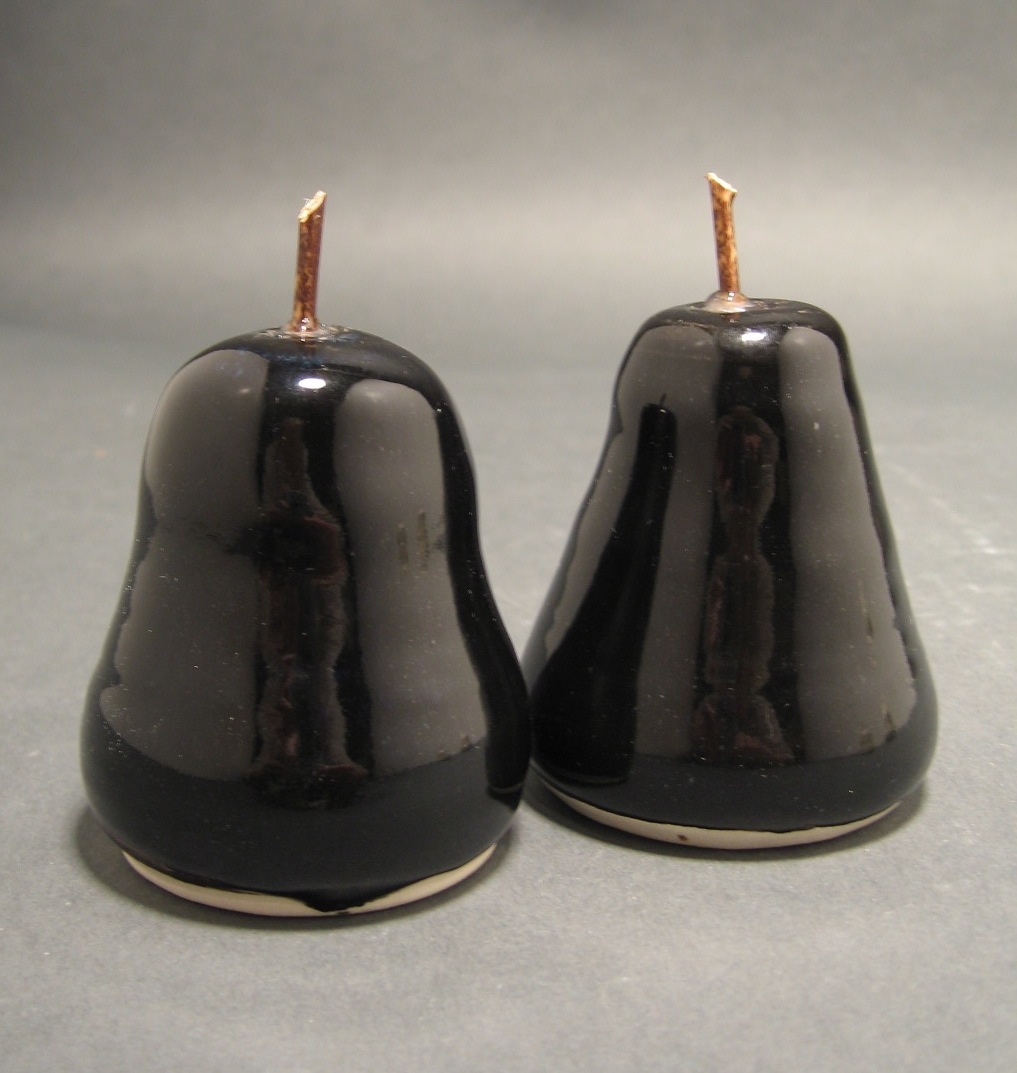
Salt and peppers are among my favorite tableware pieces to make.
I especially like the ones that distribute the salt and pepper from the bottom; the ones with no shaker holes in the top.
Here are some examples of forms and glaze treatments:
![]() |
![]() |
A pear-shaped form works best with this kind of design, but there are certainly lots of other interpretations to explore. |
| Bamboo stems |
![]() |
This is one of the first pear shakers I made. It has a very pleasing celadon glaze. Unfortunately, the stem snapped and has been glued back--so it's mine forever. |
![]() |
| This rather large shaker is by Paul Dresang. It is wood-fired. The photo doesn't really do it justice. |
Monday, May 14, 2012
Who Does She Think She Is?
This film aired on PBS this weekend. Although it was first aired in 2008, it addresses the dilemma of women artists both in regard to recognition and in the conflicts and pulls of home, children, partners and their art.
It hit the mark with examples of several women artists who have achieved recognition in their fields. For me, it was like getting a good thump in the chest. (And also a good "kick up the backside" to get out there to my studio and get to work!)
An extensive showing schedule is posted on the website. Check it out.
Note: Although this is primarily a women's issue, men who stay at home can also feel these pressures of guilt and duality upon their work.
Labels:
Art philosophy,
Artists,
professionalism
Wednesday, May 9, 2012
OPA Showcase
Just came back from the Oregon Potters' Showcase in Portland. This is one of the biggest and best shows of claywork in the country. They are celebrating their 30th year of presenting one of the best organized shows in the country.
It was nice to see and chat with my friends in Oregon who had work in this show. And I finally met Ellen Currans. She has always been working in the background and never out on the floor, but this year she was at her booth and we had a good chat. I own a couple of pieces of her work and love them.
I didn't know it until the show that Ellen was one of the original innovators who organized the first shows. Check out the OPA website to read more.
Ellen makes beautiful functional pieces and she is a master of glaze as well.
Here's a few examples from the member's show gallery. (I usually don't photograph work in the individual booths unless I get the owner's permission.)
It was nice to see and chat with my friends in Oregon who had work in this show. And I finally met Ellen Currans. She has always been working in the background and never out on the floor, but this year she was at her booth and we had a good chat. I own a couple of pieces of her work and love them.
I didn't know it until the show that Ellen was one of the original innovators who organized the first shows. Check out the OPA website to read more.
Ellen makes beautiful functional pieces and she is a master of glaze as well.Here's a few examples from the member's show gallery. (I usually don't photograph work in the individual booths unless I get the owner's permission.)
This photo is to remind me to return to the indigo lined work I did with my cat plates. It looks very ease, but believe me, it's tough to do this and do it so well as this example.
Note to self: Look for innovative handle applications.
This is a LAMP. It is stunning in real life. Wish I could have seen it illuminated.
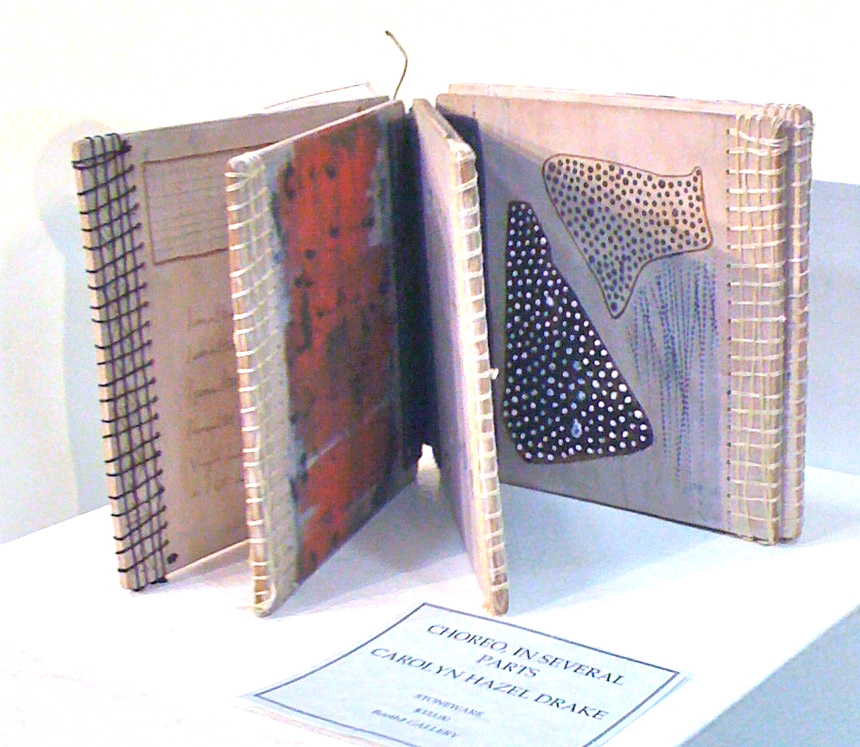
Book pages of clay. You wanted to pick it up and thumb through the pages.
The elements here are all 3-D. A novel way to present clay.
Beautifully carved - a very large platter.
This was also a large piece. I must give this technique a try some day.
I selected these pieces because of the innovation and originality of work; reminders of techniques to experiment with. Although I seem to be seeing more sculptural work as a trend, I also had the impression that brighter, more ornate work is also happening.
I can't say I am a fan of the bright colored grotesque sculpture that seems to be emerging in a lot of the shows. Looking at the posted NCECA gallery shots, these type of sculptures seem to be prevalent.
There were more iridescent glazes it seemed and some fine crystal growing going on. I'm a sucker for white crystalline pieces.
Once again, I added more bowls to my growing collection. I was conscious of the pull of oriental-inspired work that speaks to my own taste.
Tuesday, May 1, 2012
Another Lid Solution
I love this little pot.
Unfortunately, I dropped it's lid on the studio floor.
But here's another pot/lid marriage. And it's a funny one because the 'lid' started out as a tiny teacup. It still has wax on the bottom.
I will put it into a bisque kiln and burn the wax off.
This time, I'll find a trivet to go with the teapot and glaze it to match the lid.
Maybe a chocolate brown would work well.
Unfortunately, I dropped it's lid on the studio floor.
But here's another pot/lid marriage. And it's a funny one because the 'lid' started out as a tiny teacup. It still has wax on the bottom.
I will put it into a bisque kiln and burn the wax off.
Maybe a chocolate brown would work well.
Subscribe to:
Posts (Atom)