Friday, March 14, 2014

Piping and Sideboys


The following post has absolutely nothing to do with ceramics or clay or art.  It is the result of my cousin sending me an email about Navy traditions and our shared experience of spending years associated with same. And this reminded me of a bunch of experiences. So please indulge me. 

Piping and Sideboys on Navy ships


The custom of 'piping' a distinguished visitor 'over the side' dates to the time of wooden ships when senior officers would come alongside in their small launches. As the launch approached, the ship Boatswain, who was a warrant or petty officer in charge of the ship's deck crew, rigging, cables and anchors, would use his bos'n call to muster a party of men to assist the senior officer coming aboard.

 Hence, the term "piping."  

He arrived at the quarterdeck, the ship's 'front door' and assembled a working party of sailors to take their stations on either side of the senior officer who would be lifted from the launch via a 'sling'. The sling would be lowered to the launch; the officer would be strapped in and hoisted to the quarterdeck of the ship.  

As the seniority of the officer was often an indicator of his bulk, the more senior the officer, the larger the number of men would be assigned to hoist him up  and lift him "over the side"

 The more senior the officer, the more likely the bulk. Hence more sideboys were needed to assist him onboard. The same operation in reverse was performed whenever the officer returned to his launch.

Today, distinguished visitors are not hoisted aboard ship, but the sideboys and the piping functions still remain.


The above reminded me of the odd experience of being "piped" aboard a ship.  And my resultant wonderment about whether my experience was a singular one or not. I still don't know. 


The other memory this little article spurred was the fact that before leaving Japan, I bought a nice Boatswain's pipe just as a souvenir. 

It lay in a drawer for some years until we moved to a beach community. Our children had lots of room to run, but were difficult to call home in a place where the sea roared and the wind blew nearly all the time. 

The perfect solution was for me to stand on the front deck of our house and blow the Boatswain's pipe. The sound carried perfectly.


Thursday, March 6, 2014

Christa Assad

Christa Assad needs help.

This talented potter has had a disastrous house fire and has been injured in the process. Her friends have arranged this website and raffle to raise money to help her on the long road to recovery. 


The site is clearly laid out and if you choose to contribute, note which piece you would like to win by writing the artist's name in the comments section in the contribution process where you place your name and comments.

http://www.youcaring.com/medical-fundraiser/help-christa-assad-get-muddy-again-/143960


Thursday, February 6, 2014

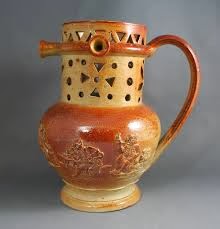
Puzzle Jugs


http://www.dump.com/puzzlejug/

Check out this outstanding video that explains how to make a puzzle jug.

Definitely want to try my hand at this some day.

Friday, January 24, 2014

Hiatus


Angry Cat - Quick brush drawing using stain.


Sorry I haven't posted anything for a while....Life has an uncanny way of interfering with, well, Life--- A lot of 'outer' life has interrupted 'inner' life for the moment and I don't have a full studio to work with yet..........let alone a full deck.

Badda bam.

We sold our house. And the building my studio was in. And we moved it ALL into a smaller house.

Nuff said?  I've been sorting, shuffling, packing, donating, unpacking sorting, moving, repacking, selling, ever since. You'd think I would lose some weight, wouldn't you?


Come spring, it's going to be one big garage sale, I can tell you.


So, in the meantime, I am doing some research and a lot of thinking and writing; just not a lot of art.  Do I need to say it's a bit frustrating?

I am, however, working toward getting a studio reassembled and also on designing renovations for the new house.

See you soon.......


Sunday, November 3, 2013

Using Architecture as Inspiration


I once took a Lana Wilson workshop on building boxes. She is an expert and I learned a lot.

I searched for an image of one of the boxes on the web and couldn't find any. But I remember it vividly.  At first glance, the finished piece looked like a standing sculpture with applied panels and images. But those of us who watched her build it, we knew that each feature hid a secret compartment.

A flat panel with a face sculpture applied to it slid out to reveal a drawer. Rotating to the back revealed a window, as in this piece, but the window was really the backside of another drawer located on the front behind another panel.

I also recall a jewel box that had what looked like a raised column on the lid, but if you  pulled it up, you found that the column was really a long compartment that fitted into the lid. 


I've had a photo like this one in my files for years---because I want to build a complex box sculpture based on Tibetan monasteries.

I want to make little secret compartments and hidden drawers, lids that don't look like lids that open, pull-up pieces that conceal hidden chambers, sliding panels and surprises.

It's fun to just sit and diagram or plot out designs.


How many hidden rooms and passages do you suppose are in here, if at all?


Monday, October 28, 2013

Interpretation


Featured Tiles:  I like to think of this set of tiles as an example of relationships:

The tile on the left is the opening statement:  "This is what I am; This is the standard."


The tile on the right is a variation or response:  It takes the example of the above and elaborates as if it were saying, "I accept your statement and respond. I am an elaboration of you." Or, "I see your bid and raise you one."


Also working in this design dynamic is the shape and strong black framing of both tiles, bouncing the eye back and forth toward the center. The outer curves work in the same way, leading the eye back and forth between the tile: The left tile has a larger outer margin on the far left; the right tile sweeps toward the far right border, but a similar strong outer border on the right and the strong vertical in the center of the image stops the eye at the far right. 


The tree-like center designs are isolated as images, but relate to each other in motion toward the center, also bouncing the eye back and forth, yet slowing the flow by corresponding dark verticals.

How wide the center division between the two tiles is also important. If hung too widely apart, this dynamic would not work as well.


I don't think these things as I am working. These design elements are almost subconscious and are part of an artist's "eye". They either look right or they don't.


This same back and forth happens a lot in music:  Theme and Variation and so it can be in clay.

So, what do you think is going on here?

These guys are fun to move around to get different impressions.

Friday, October 25, 2013

Being Your Own Inspiration


Many times we go to workshops, seminars and conventions, listen to lectures, buy books, watch demonstrations, try our hand at new techniques and become inspired to create new works.

It's good to feed that creativity and sharpen skills,

But

Sometimes in all the flood of the new, the exciting, the dazzle, we can lose ourselves.


That's why it is a good idea to keep alive all the essence of what you and you alone can do.

Keep a good record of your work to remind yourself where you were going with a certain piece; make a note of construction, alterations, glazing and firing as well as what inspired you to make it or what your thoughts were while you were in the process.

I used to think I would make only one piece each time, but I have come to think that making two is better, at least for me.

 I also like to set the finished work in front of me and take a good look at it. I make notes about what problems I encountered, what surprises happened and what I would do if I made it again.

Those are written in the margins of my journal that I keep as I throw or construct work, through the glazing process and after firing. That way the whole history of a piece is located in one place. And I don't really care if it is messy or not. Sometimes fast is better than neat.


Sunday, September 22, 2013

Inspiration can come from anywhere......


This is one of my favorite movies.

And when I finished the piece below, I named it, "Count Olaf".

I chuckle every time I look at it.


The piece is about seven inches tall, made by slabbing out some porcelain, impressing it with pieces of styrofoam packing material, a sea shell, comb, and a palm-sized piece of car tail light picked up in a parking lot.


Really, I started with a freeform teardrop shape for the base.

For the sides, I made a pattern drawn on newspaper and cut out makes the shape for the two sides of the piece.

I join the two sides using a score tool and clay worms and coax it into a standing form. This has to be done by using a very light touch because I'm working with rather wet clay. I prefer to join these kinds of pieces while they are soft. It makes for better seams. I have to be very careful not to disturb the outside design.

I shape the spout, making it bulge at the base, roll the back over and smoothing it out.

I put the flattened ball of clay 'button' at the point where the form makes a radical change. This is really to reinforce the change of direction that stresses the clay. And it makes a very good design element.

I also manipulate the form mostly from the inside with dampened fingers, pushing it in or out to manipulate and emphasize the curves. And I lightly support the outside while I'm doing it.


The glaze is an iron glaze with a creamy rutile liner and the piece is fired at a cone 5/6 oxidation.


Tuesday, September 17, 2013

Jottings: "Art Advice"


Since, at the moment I don't have access to clay or equipment, I have been spending time "cleaning out" my computer.

 "My dirty old computer"-that commercial cracks me up.

++++++

**Segway Warning**

Can you become a computer hoarder?
I think so.

++++++

Anyway


In my frustration and because my MAC is now screaming to me that the Startup Disc is full and I can't download things and need to unload files,  I ran across a stored document called,


 Art Advice: Random Thoughts about You and Your Work


The first 10 years are the hardest.

Break a lot of bad pots.
Keep a lot of bad pots, but only as a reference.

Surrender to your art. 
Recognize it is an organic need for you. 
Don't apologize for taking time to pursue it.

Follow every impulse. 

Do It, 
Even though it has not been done before by you or anyone else. 
Even if it seems crazy, 
Do it.

Don’t persist in trying to ‘heal’ a bad pot; chuck it and make a better one.

Strive to know your flaws and work to correct them.
Learn from your mistakes.. 
Make notes about your mistakes so you will remember them.

Keep your best work.

Find other artists to talk to. They understand creative madness.

Flex your creative muscles every day:  
Sketch, read, dream, plan, make:  
Whatever needs doing and whatever dreaming need to be dreamed. 
Make it a daily habit. 
Inches add up to miles.

Photograph everything you make.

Take notes about your work. Your initial intention, the happy mistakes that happen, techniques, inspirations, whatever you will need to think about, whatever you see or do. You may think you'll remember later, but sometimes ideas are fleeting. 
You don't want them to get away.

Search out your own truth and keep returning to your own themes.

Keep pictures or examples of your inspirations.

Copying an IDEA is good; duplicating another artist’s WORK---not so good.  
It robs them and robs you.

Build a reference library: Keep the books that are relevant, sell the others

Avoid looking at ugly.

Listen to everybody. 
Ignore bad advice.  

Keep only what feeds you.

Strive to master the medium.

Don’t worry about Style, worry about Skill.

Set your standards high. 
I mean HIGH. 
So high you will always have to chase them.

Don’t worry or ask yourself, ‘Is it good enough?’ 
It’s good enough until you can make better.

Find your market niche.

If you need a tool, figure out how to find it or make it.  
If you can’t, find a good craftsman to make it for you.

Take care of your tools.

Keep learning. Don't rely on somebody else to teach everything you need to know. 
Teach yourself whenever you can; you will learn better that way.

Find your own best work environment, be it solitude or group, silence, music or talk, sloppy or neat, etc. 

If a piece does not sell, pack it up and don't look at it for a long time. Then, unpack it and look at it again. Decide if it should be kept, sold or destroyed.

Don't offer anything for sale you would be embarrassed to see again.

Live with your pots. What looks great today may not look so great tomorrow. And surprisingly, vice versa.

Don't get into a rut. 
Everybody's work changes even a little bit. Embrace it.

Don't take yourself too seriously, but seriously enough.


Tuesday, September 3, 2013

CLAYART


How can I explain CLAYART? 

It is an internet community of people involved in clay: Artists, publishers, gurus, authors, equipment experts, educators, amateurs, gallery owners, hobbyists, newbies and old hands.

The physical boundaries have no end. Anywhere that an internet and computer are available, CLAYART exists. It is one enormous club. There are no dues, no initiation, no jury, only the requirements of civility and everyday grace you would exhibit and experience.


After a NCECA convention in Las Vegas about 18 years ago, an email discussion group that would evolve into CLAYART was formed to carry on the dialogue that had been started by the conference. The initial group wanted to continue the flow of information about all things clay. And we wanted to keep up the network that had begun with other potters.

Today. it has grown into a huge population with a daily traffic that can amount to around 100 messages or more. (I really don't keep track.) That could be daunting if you set out to read every word of every email, but you quickly learn to pick and choose what is relevant to your own environment and delete (in my case, mercilessly) that which you judge can be eliminated. Most of the time, the Subject Line and the sender will tip you off as to whether you choose to read or not. I pass up raku or woodfiring, for instance.

And, a subject-word-keyed archive can be used to research a particular question that might arise, so elimination of messages doesn't usually mean they are gone forever.

Additionally, once you are enrolled, you can address the CLAYART "Brain" to ask an open question. The avalanche of replies or opinions will almost fall from the screen. We are a helpful and giving folk in the main.

It is helpful, as in any new environment, to sit back and observe the protocols and 'lurk' until you're comfortable, but it you have a bad problem or want to respond right away, that's okay too.

Mel Jacobson (or "The Mayor" http://visi.com/~melpots/) runs it most of the time along with a couple of other volunteers and serves as a basically hands-off moderator yet knows when to 'send us to our rooms' when things occasionally get too hot or protracted. In other words, telling us to 'ride that dead horse outta here.' But in a good way.

Current discussion has included the question of making donations to charity. (You cannot write off the price of the piece you give, contrary to common folklore; only the cost of your materials can be taken off your income taxes. The discussion suggests how to say, 'no' politely and some win-win solutions for dealing with organizers.)


Make a visit by joining. (link below) Get your toes wet. Follow the directions and wait. It won't be long until your mailbox will be bubbling with a plethora of subjects.

Beside being an internet discussion group, CLAYART is also a sub-community that meets within the yearly NCECA (National Council for Education in the Ceramic Arts) convention.  

Depending on the year and circumstances, CLAYART secures a large meeting-type room at the location for the group meeting place  throughout the time of the convention in order to relax, talk, show our work, trade, present mini-programs and meet in real-time with members  manifest in the flesh who we have come to know from the ether. 

At the end of the convention, we have a mug exchange drawing which is great fun.

We all walk around NCECA with our nametags showing a red dot as a way of recognizing each other amid the masses. (People involved in clay are for the most part a truly friendly lot anyway.)