Friday, May 9, 2014

Clay Frogs


I once made a frog of combination clay and metal similar to this one. The upper framework was in clay and held up well during the firing.


This cylinder shaped frog is a pretty standard frog design. Good and stable, weighty, no-nonsense frog.


Same goes for the rounded one. I like the taller form. Plenty of room for the water reservoir.

One like this could stand alone, but tiny feet are advised to keep dampness off the surface it would sit on. Or it would work in another clay piece.

The winner here is a beautiful oxblood glaze.


Nice pairing of bowl and frog here.

If the frog were made taller in this one, it would take on a whole different look.

I like the combination of flower stem holes and the sculptured surface, but I'm not so sure it would show if flowers were in the bowl.

Another example.


This is the real winner. Great proportion between the frog and bowl. It looks like the frog just landed in the middle of the bowl.

 The design would harmonize with any kind of flower.


Thursday, May 1, 2014

Scarf Dancers, A New Discovery!


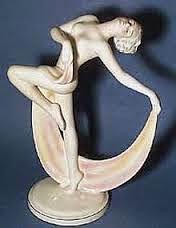
While searching for the "September Morn" painting and flower frog, I discovered a whole new world of 'Scarf Dancers'.


Most of these were made in Germany pre-Second World War.

And later copied for sale in the U.S.


 Some are better than others.


And can be very dramatic.


 This one met Goldfinger.


After she met Goldfinger.


Sometimes they bring friends.


Tuesday, April 29, 2014

Glass Flower Frogs


Many of the art glass companies made flower frogs during the early 1900s to about 1950. Many designs could well be inspiration to potters. 

I remember a very large. shallow bowl made of black glass with a scalloped edge with a center area for a matching frog that was a "Very chilly nekked lady in a lake". She was about 6 inches tall and looked like this.

She did most of her standing in the attic, however--mostly due to the fact we lived in a small, conservative town.

I can remember only a few times when she stood in a grouping of daffodils, though, and I thought she was beautiful.


A lot of glass companies made simple frogs as well as sculptural pieces like this.


Some work better in glass. Especially as in this example of a green glass 'brick' form. It would be quite pleasing with the flower stems showing through the bottom.

This won't work in clay, but the form is nice. A great glaze or design on the face might be a good opportunity.

Somewhere I have seen a similar vase by Paul Gauguin.  Did you know he made many ceramic pieces? Undervalued, in my opinion

Clear glass is successful because it seems to disappear as in the next frogs. I don't know about Lalique, but I know Baccarat made some flower frog pieces.

The clear two-pieced set one sold at Christies for $250.


Tall vases with a removable frog in the top works well in clay. As a matter of fact, I made a couple of these and they were very successful.  The frog rested on a small ridge and could be removed so the vase could be used for used in another way. 

The same could be said for the next two bulbous vases. A pierced lid could be made either with the criss-cross motif or with holes in it. These two are technically rose bowls. Anything with a metal criss-cross flower holder is classified as such. The rounded shape just screams for a great, runny glaze. 


This is a unique take by Tiffany. I'm not too sure how it would look with flowers; you would surely want to let the bottom of the bowl design show.....


Saturday, April 26, 2014

Flower Frogs

After a long, wet and cold winter, the trees and bushes are budding and early flowers are virtually leaping out of the ground.

This puts me in mind of the flower frogs I used to make for shows. One of those fill-the-corners-of-the-kiln things that "paid the rent".

Definitely a niche item. I wouldn't have even thought of making them if a lady hadn't described what a pansy frog was and requested I make one for her. Since she was a friend, I made her one and then tried including some at a show. They were great little sellers and fairly easy to make.

You know how it is. Every show you have someone who wants you to make something for them and usually I  take a dim view of this having been stung a couple of times stuck with a piece I had made and the buyer having evaporated.

I still have a custom made salt and pepper dispenser set designed to fit a particular stove niche......

Anyway

the flower frog request sent me off on a mission to expand my knowledge about their different shapes and history. I remember seeing them at my grandmothers' and aunt's houses. We had a few in the house I grew up in.


I have a couple of antique flower frogs I've picked up along the way.

The first is a Japanese one made to suggest lotus leaves. It is designed to sit inside another vessel and support either a grouping of flower stems for each hole or quite large stems like iris or lily plants.
Large, tall flowers and this small frog might present a problem. I have never understood why frogs are so short. This one makes more sense.

The pink example is currently on eBay for $12.00.


Vintage Flower Frog ~ Flower Pedals Design ~ Made in Japan
The other piece that was in my mother's things. For years I had no clue about what it was. It is a variation of a pansy frog.

The slots are for tiny blossoms with stems that are too weak to support themselves. They are threaded into the slots and into the water reservoir  filled from the top.

This one is a McCoy Pottery piece and can be found in antique shops.

Flower frogs might work as kiln fillers and could be successful for sales in garden shows, at nurseries or art fairs.

More about frogs in the next post.


Friday, April 18, 2014

India or China?

I inherited this unusual vintage pot from my husband's family. I'm guessing from the design, it was made around 1920-30. This pot was made in many different colors and sometimes with an applied gold trim.

The divided pot was so the hostess could offer her guests either tea from or China.  Very elegant, yes?

Beside the Twinspout Tea Master make, the Hall Tea company made a lot of teapots that look like this, although they were usually made without two chambers.

The last time I checked, this pot is worth around $200.00 because it is in perfect condition.

There is a kiln mark on the foot, but these are usually overlooked in evaluations. And evaluations vary according to how they are framed. Insurance evals are higher because they refer to replacement values. Auction prices are much lower because they are for a quick sale. The real value is somewhere in between. Also prices will vary according to the way a market swings.


So once the pot is filled with tea, how do you tell which side has which tea? 

There are very subtle 'touch and sight' clues that aren't apparent at first sight.

The handle has very slight ridges over one spout. Some other pots have a more obvious 'thumb stop' or knob on one side or the other.  
And you can barely see an impressed arrow on the left-hand galley pointing to one chamber. It is the chamber closest to the ridged side of the handle.

Also, you would think the lid would fit no matter which way you put it on. But it only fits one way. The clue is also a subtle arrow impressed into the claybody.
Next time you see one of these in an antiques store, check it out.


Saturday, April 5, 2014

More Teapots

I haven't seen this book yet, but I'm sure it's as good as the first one.

Below:

Ann Hirondale's two pots. I never get tired of looking at these.

She offered a great class some years ago.

These pots are surprisingly light when you pick them up.


Unfortunately, I don't know who made this beauty.


Or this one, but it looks like a commercial pot. Nice shape all the same.
A Fine Mess Pottery.

A gaggle of teapots?

No, that's geese.


Maybe a Twitter of Teapots.

These last two are by Sequoia Miller.


Wednesday, April 2, 2014

Teapots, Teapots, Teapots

I love looking at teapots.

While cleaning out my 'dirty old computer' (that commercial just cracks me up) I ran across a file of nothing but teapots.  Enjoy!


By my friend, Gayle Bair, absolutely beautiful work.


Lisa Quals

Haven't figured out the spout, though. 


Meryl Ruth
I'd love to see one of her pots for real.

By Nils Lou


This silver pot is in the Renwick Museum in Washington, D.C.  Sometimes silver pieces can be great inspiration for potters. I love the handle.  And the handmade look of it.


Unfortunately, I don't know who make this lovely thing.  Beautiful positive and negative space and symmetry.


Tiny Tea, one of mine.
Tim Storey

Sunday, March 30, 2014

Selling

I've just been reading an interesting discussion on CLAYART* email about selling on Etsy.  Some potters evidently are doing well--especially if they are offering those "Make your Rent" kinds of things that sell for around $20.00.

Even though it rankles me to do it too, I have also make those little kiln-fillers for sale. I'm not saying anything about individual's potter's choices. I'm speaking for myself totally.

As a matter of fact, it always amazes me that a lot of show patrons will buy several little things like this when, at the end of the day, they could have spent the same amount and come away with a single treasure.

Anyway, back to the discussion.

It seems that I've heard this kind of sales song before. Those who make the "Make your Rent" stuff and work out a simple plan are doing okay. But, like shows, it's patchy. And, it seems, the fees for listing, and other special features can add up in a hurry.

Shows offer space at a price. Shows attract buyers. Artists set up booths and sell their work and if they are lucky, they make a profit. Seems like the same thing happens with sites like eBay and Etsy. The venue is offered, artists make stuff and the promoters are the ones who really make the money.

There must be a better way.


*CLAYART is an international discussion group open to potters, suppliers, etc. of all things clay. If you want more details, comment and I will send you the information. I learn something new every time I read it.